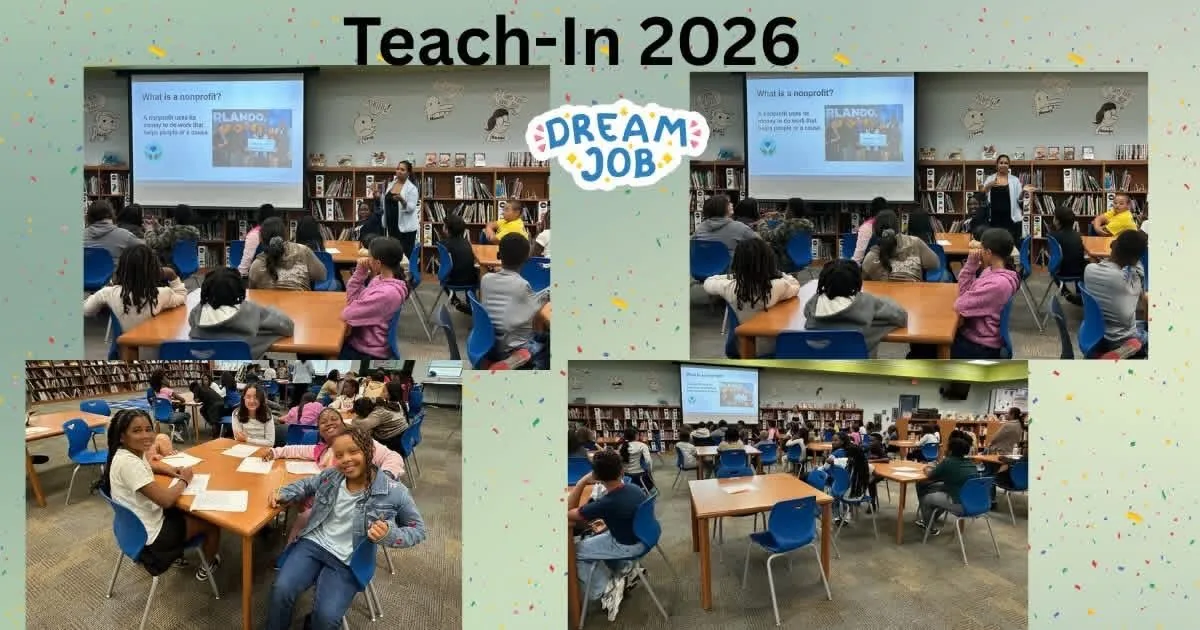
At a Central Florida elementary school Teach-In, Building Our Tech (BOT) Executive Director Safia Porter turned a class into pretend tech startups. Each team had a founder, user researcher, designer, developer, and marketer. Each team picked a real school problem and invented a fix, including a voice-activated pencil case for students who are blind or have low vision. The lesson for adult founders is the same: start with a person and a real problem, then break it into steps a team can solve together.
A surprise visit to my daughter’s class
My favorite part of the Teach-In was walking into my daughter’s classroom. She had no idea I was coming. The look on her face when she saw me at the front of the room is one I’ll keep for a long time.
Then her classmates and I got to work. For one morning, a room of elementary students became tech founders. What they built, and how they built it, is the same process we use with adult founders across Central Florida.
How do you explain a tech nonprofit to kids?
I introduced myself as Ms. Safia. I explained that a nonprofit is an organization that exists to help people, not to make money for owners. Building Our Tech (BOT) helps people in Central Florida learn tech skills and start businesses. My job is to help founders figure out what to try next.
That last part is really about asking good questions and coming up with solutions. So I gave the class the same three questions I use with founders:
- Who needs help?
- What are they trying to do?
- What could you make to help?
These questions break a big, fuzzy idea into pieces small enough to act on. Kids got it right away.
What roles does a startup team need?
For the Kidpreneur Challenge, students formed pretend tech startups. Every team member had a job, and every job mirrored a real startup role.
| Role | What the student did | What it looks like in a real startup |
|---|---|---|
| Founder | Gathered ideas and named the problem | Sets direction and keeps the team focused on one goal |
| User researcher | Figured out who needed help | Talks to customers to learn what they actually struggle with |
| Designer | Drew the idea | Turns the concept into something people can see and react to |
| Developer | Explained how it would work | Builds the product and solves technical problems |
| Marketer | Said why it would help | Explains the value so the right people want it |
Everyone had a way to participate, even if their part was holding up the drawing. That matters. When each person owns one piece of the problem, a team moves faster and is more invested in the outcome.
How do you break a problem into steps?
Each team followed the same five steps:
- Spot a problem at school.
- Decide who has that problem.
- Think up an invention that could help.
- Name it and draw it.
- Show how it would work.
To present, teams filled in one sentence: “We invented ___. It helps ___ by ___.” That single line forces clarity. If you can’t fill in the blanks, you don’t understand the problem yet.
Before the teams started, I modeled the steps with my own example invention, the Wrapper Scout drone. I walked through who it helps, what problem it solves, and how it would work. Seeing one idea go from problem to pitch gave the kids a map to follow.
What did the elementary students invent?
The ideas came fast, and every one started with a real problem the students see at school:
- An AI-powered lunchroom robot that cleans up after lunch.
- Wayfinding robots and software that help students find their classrooms and help parents find their way during open house.
- A recess helper that makes it easier to pick what to play.
- A library book finder that helps students discover books they’d actually love.
- A voice-activated pencil case that hands supplies to students who are blind or have low vision.
The invention that stayed with me: a voice-activated pencil case
One team thought about a classmate’s day from a completely different angle. They asked what it’s like to reach into a pencil case when you can’t see what’s inside. Their answer was a pencil case you talk to. Ask for a pencil, an eraser, or a highlighter, and it hands you the right one.
That idea didn’t come from a cool piece of technology. It came from empathy. The team started with a specific person, a student who is blind or has low vision, and a small moment of frustration that person faces every day. The invention followed from there.
What can founders learn from kid inventors?
These students weren’t more creative than adult founders. They had something many founders lack: access. In one morning, they had a clear framework, a full team with defined roles, simple tools, and one shared goal. With those in place, every team produced an idea worth pitching.
Three lessons carry straight over to founders in Central Florida:
- Start with a person, not a product. The best ideas in the room began with “who needs help?” Founders who skip that question often build something nobody asked for.
- Break the problem into small steps. Five simple steps turned a vague idea into a pitch. Founders can do the same: name the user, name the problem, then test one small fix at a time.
- Give everyone a role and one goal. A founder doesn’t need to be the researcher, designer, developer, and marketer at once. Access to the right team and tools turns a solo struggle into shared progress.
That’s the work we do at Building Our Tech. We connect founders to the skills, tools, and people that help them learn, build, and scale. And we keep coming back to the same habit those students practiced: start with a person and a problem they actually experience.
Frequently asked questions
What is the Kidpreneur Challenge? The Kidpreneur Challenge is a classroom activity led by Building Our Tech. Students form pretend tech startups, spot a real problem at school, and invent a solution. Each student plays a startup role: founder, user researcher, designer, developer, or marketer.
What is Building Our Tech? Building Our Tech (BOT) is a nonprofit that helps the Central Florida community learn, build, and scale in tech. BOT helps people learn tech skills, start businesses, and figure out what to try next.
What three questions help founders find a problem worth solving? Ask: Who needs help? What are they trying to do? What could you make to help? These questions keep a founder focused on a real person and a real problem.
How can founders break down a big problem? Name who has the problem, describe what they’re trying to do, brainstorm one invention, sketch it, then explain how it would work. A one-line pitch, “We invented ___. It helps ___ by ___,” tests whether the idea is clear.
Why does access matter for founders? Access to tools, a framework, and a team with clear roles lets founders make progress faster. The students in this Teach-In each produced a pitch in one session because those pieces were in place.
Build with BOT
Are you a Central Florida founder with an idea and a person you want to help? Building Our Tech can help you take the next step. Explore our founder programs, including the incubator and accelerator.
Want to bring a Teach-In like this to your classroom or volunteer with BOT? Get in touch or sign up to volunteer.